
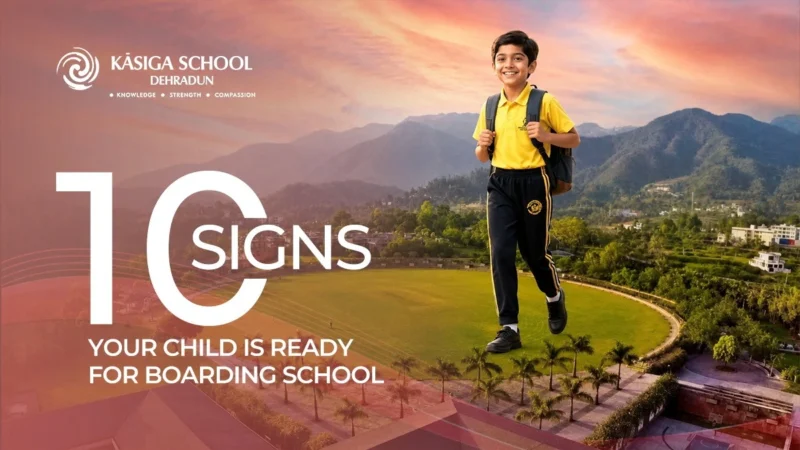
Wondering if your child is actually ready for boarding school or if you’re just hoping they are because it feels like the right move?
A child is usually ready when they can handle a bit of distance from home, look after their own basic routine, get along with other kids without a parent stepping in and show curiosity about trying new things on their own. If most of that sounds familiar, you’re probably not far off. But let’s go through this properly, because “ready” looks a little different for every child and it helps to know exactly what you’re looking for.
Every parent thinking about a boarding school for children goes through the same loop of doubts. Is my child too young? Will they manage without me around every day? What if they’re homesick for weeks? These are fair questions and there’s no perfect age or checklist that applies to every single kid. But there are patterns. Certain behaviours and habits tend to show up in children who settle into residential life well and once you know what to look for, the decision gets a lot less confusing.
1. They Can Manage Their Own Daily Routine
If your child can get themselves ready in the morning, keep track of their own belongings and follow a basic schedule without constant reminders, that’s a strong starting point.
Boarding life runs on routine — wake-up times, meals, prep hours, lights out — and kids who already have some grip on managing their own day tend to adjust faster than those who need a parent hovering over every step.
2. They’ve Shown Interest in Sleepovers or Camps
Has your child ever come back from a school trip, a cousin’s house or a summer camp and actually enjoyed it? That’s a meaningful data point. It tells you they can sleep somewhere unfamiliar, eat different food and go a few days without you nearby, all without falling apart.
3. They Make Friends Easily
Boarding school is, in many ways, a lesson in community living. Children who can strike up conversations, join a group activity without being pushed or bounce back after a small disagreement with a friend usually find it easier to build a support system away from home.
4. They Can Handle Being Told “No” Without Spiralling
This one’s underrated. Kids who are used to some structure and boundaries at home — who can accept a “no” or a rule without a meltdown — tend to cope better with the discipline and shared living guidelines that come with a hostel setup.
5. They’re Curious About Trying New Things
A child who’s genuinely excited to try a new sport, join a club or pick up a hobby they’ve never touched before is showing you something important — they’re open to growth.
Boarding schools with strong co-curricular programmes thrive on this kind of curiosity and it’s part of the reason sports infrastructure and facilities matter so much in a residential setup because kids who want to explore need the right environment to do it in.
6. They Can Solve Small Problems on Their Own
Forgot their water bottle? Lost a pencil box? Had a disagreement over who goes first in a game? If your child can work through these small, everyday hiccups without immediately needing an adult to fix it, that’s a sign of the independence boarding life asks for.
7. They Talk About Missing You, Not Fearing Being Away
There’s a difference between a child saying “I’ll miss you” and a child saying “I don’t want to be away from you, ever.” The first is a completely normal, healthy emotion. The second usually signals more anxiety around separation than a school environment alone can resolve and it’s worth having an honest conversation with your child before making the decision.
8. They’re Physically and Emotionally at an Age Where Structure Helps
Most residential schools including ours, start boarding from around Grade IV or V and there’s a reason for that. By this age, children are old enough to grasp routine, responsibility and social dynamics but still young enough to adapt without too much resistance. If your child falls in this bracket and shows the traits above, age is unlikely to be the obstacle.
9. They Respond Well to Guidance from Adults Outside the Family
A child who can take instruction from a teacher, coach or house parent — not just from mom or dad — will find the transition to hostel life smoother. Boarding schools rely on a wider support system of wardens, counsellors and mentors and children who are open to that guidance settle in faster.
10. They (and You) Feel Ready for the Bigger Picture
Beyond the day-to-day, ask yourself if your child understands why this move matters — better exposure, stronger academics, a more disciplined routine and friendships that often last a lifetime. When a child grasps even a little of that bigger picture, the transition tends to feel like an adventure rather than a punishment.
What Are the Real Boarding School Benefits?
Once you’ve gone through these signs, it helps to understand what your child actually stands to gain. The boarding school benefits parents notice most often include:
- Stronger independence and time-management skills
- Better social confidence from constant peer interaction
- A structured routine that supports both academics and health
- Round-the-clock access to mentors, counsellors and pastoral staff
- Exposure to a diverse group of students from different backgrounds and cultures
- A more focused, distraction-free environment for studies and hobbies
Most of these benefits come from the everyday structure a well-run residential school provides — the kind of consistent pastoral care and student counselling support that helps children settle in without losing that sense of being looked after.
Final Thoughts
Deciding whether your child is ready for boarding school isn’t about ticking every single box on a list — it’s about noticing the overall pattern. Can they manage a routine? Do they make friends easily? Can they handle small setbacks without falling apart? Are they curious rather than fearful about trying something new? If you’re seeing most of these signs, your child is likely more ready than you’re giving them credit for and choosing the right boarding school for children at this stage can genuinely shape how confidently they grow up.
This is exactly where Kāsiga School comes in. Located on the Dehradun–Mussoorie highway in Village Purkul, Kāsiga is a co-ed residential school for Grades IV to XII, affiliated to both CBSE and CAIE which means families get the choice between a familiar Indian curriculum and an internationally recognised one under the same roof.
What makes the boarding experience at Kāsiga work for children stepping away from home for the first time is the structure built around them — dedicated pastoral care staff, a full-time student counselling team, safe and well-supervised hostel life, strong health facilities and a genuine focus on holistic development through sports, clubs and excursions rather than academics alone. If your child is showing the signs of readiness we’ve talked about here, Kāsiga’s boarding life is designed to meet them exactly where they are and help them grow into confident, independent and well-rounded individuals over the years that follow.