
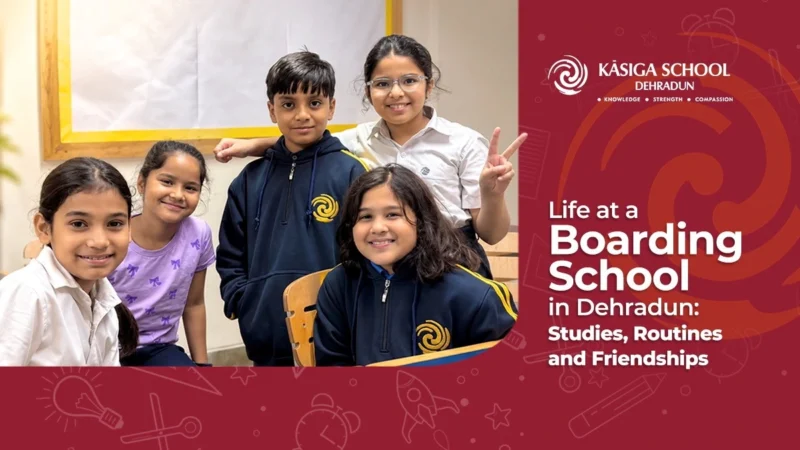
Ask any boarding school parent what actually worried them before their child left home and it’s rarely academics. It’s the smaller stuff — who they’ll eat with, whether they’ll make friends, if someone will notice if they’re having a rough week. Boarding school life in Dehradun, especially in a campus set away from the city, tends to answer those questions differently than people expect.
Life at a boarding school in Dehradun typically revolves around three things — structured academics, a daily routine built around study, meals and activities and close friendships formed through shared living. Houses, pastoral care staff and a multicultural student community all play a role in making it feel like a home, not just a school.
Studies — More Structure Than Most Day Schools
Academics at a boarding school tend to be less about cramming and more about consistency. With everyone living on campus, study time isn’t squeezed in after a commute or between other commitments — it’s simply part of the day.
At Kasiga School, this plays out through:
- Both CBSE and CAIE (including IGCSE and AS & A Levels) offered on the same campus so students aren’t boxed into one curriculum too early
- Structured study hours built into the daily schedule, not left to chance
- Well-equipped science labs and a dedicated Design & Technology lab for hands-on subjects
- Guidance on study patterns and academic pathways as part of the school’s pastoral care system, not treated as a separate add-on
The result tends to be a more even academic pace through the year, since there’s less start-stop between school and home study time.
What IGCSE Actually Offers
IGCSE stands for International General Certificate of Secondary Education, awarded by Cambridge International Education in the UK. It’s typically taken across Grades 9 and 10, followed by AS and A Levels in Grades 11 and 12.
The format leans more toward application and understanding rather than pure memorisation. Subject choice tends to be more flexible too, letting a student lean into what they’re actually good at instead of following one fixed combination. Because the qualification runs in over 160 countries, it’s a system international admissions teams already recognise on sight without needing extra context on what it means.
Routines — A Day That Actually Has a Rhythm
One thing that surprises a lot of parents is how much of boarding school student life is simply about routine. Meals, study blocks, sports and downtime all happen on a predictable schedule which turns out to matter more for kids than it sounds like on paper.
At Kāsiga, this includes:
- Meals planned with a qualified nutritionist, rather than left to a standard mess menu
- Dedicated time for sports and co-curricular activities, supported by specialised coaches
- Structured study hours in the evening with support available for students who need it
- Common downtime built into each house, where students actually get to just be kids
It’s this rhythm, more than any single feature, that tends to make the adjustment to boarding life smoother than parents expect.
Friendships — Built Around the House System
This is probably the part that surprises new boarding parents the most — how quickly friendships form when children are genuinely living together, not just attending the same classes.
At Kāsiga, students are divided into four houses — Pacific, Amazon, Everest and Nile — each with its own boarding area, housemaster, resident tutor and matron. Each house also has a common room where students gather to watch television, play board games or just hang out which ends up being where a lot of the day’s real bonding happens.
The community itself adds another layer to this. Kasiga’s boarding houses bring together students from different parts of India and from other countries so friendships often cross backgrounds and languages in a way that’s harder to replicate in a regular day school setting.
Pastoral care at the school actively builds on this too, through team-building activities and service projects designed to create a genuine sense of belonging rather than leaving it to chance. We’ve covered how this house system actually functions day-to-day in Hostel Life at Kāsiga which goes into more detail on how each house operates.
The Support That Sits Behind All of It
None of this works well without support running quietly in the background. Pastoral care at Kasiga covers everything from routine encouragement to counselling for students dealing with homesickness, stress or personal setbacks. Health facilities are available on campus too so day-to-day concerns don’t need to turn into a bigger production than necessary.
This is a part of boarding school life in Dehradun that often gets overlooked in favour of academics or facilities but it’s usually what parents end up caring about most once their child has actually settled in.
If you’re weighing how boarding schools handle a child’s emotional wellbeing more broadly, How Boarding Schools Support Students’ Mental Health and Wellbeing is worth a read alongside this one.
Conclusion
Put together, studies, routine and friendships aren’t really three separate things at a boarding school — they overlap constantly. A good academic structure supports a steady routine and that same routine is what gives students the time and space to build real friendships, not just classroom acquaintances.
Kasiga School reflects this well as a CBSE boarding school in Dehradun that also runs the full Cambridge (CAIE) pathway on the same campus. Set on a 35-acre site off the Dehradun–Mussoorie Highway, in the foothills of the Himalayas, the school combines structured academics with a house system, pastoral care and a genuinely multicultural student community. For families exploring boarding school life in Dehradun, it’s this combination — solid studies, a dependable daily routine and friendships that form naturally through shared house life — that tends to define what a child actually takes away from their years at Kāsiga, long after they’ve left campus.