
A good boarding school gets a few things right at once — solid academics, a genuinely safe campus, teachers who care, comfortable hostels, real emotional support and enough sports and activities so that kids aren’t just studying all day. Miss even one of these and the rest doesn’t matter as much as parents think.
In today’s time, you can’t really pick a boarding school off a website. Rankings look convincing, brochures all say “holistic development,” and somehow every school claims to have the best of everything. But the schools that actually work for a child come down to a handful of practical things — how safe the place really is, whether teachers notice when a kid’s struggling, what the hostel food is like, whether there’s room to breathe outside of textbooks.
Most parents figure this out eventually. But the ones searching for good boarding schools in India right now should rather figure it out before enrolling which is fair. Thus on that note, today’s guide walks through what actually separates good boarding schools from ones that just look impressive in a prospectus.
What Makes a Boarding School a Good Choice?
Honestly, it’s a balancing act more than a checklist. A school heavy on academics but light on everything else tends to produce kids who ace exams and struggle with basic confidence later. One that’s all sports and no structure has the opposite problem.
What you actually want is academics, discipline, some room for independence, real-world life skills and social growth — all pulling in the same direction instead of competing with each other. Schools that get this balance right rarely need to advertise it.
Key Things Parents Should Look for in a Boarding School
1. Academic Quality and Curriculum
Board choice matters first — CBSE, ICSE or IGCSE/Cambridge, each suits a different kind of student and future path. But don’t stop at the board. Ask how the school handles a kid who’s behind in a subject. Toppers get all the attention in brochures; what happens to everyone else tells you more.
2. Campus Safety and Security
This is one thing that’s non-negotiable and worth being blunt about. Supervision around the clock, controlled hostel access, cameras where they should be, an actual emergency plan someone can explain to you without hesitating. If a school gets cagey when you ask direct safety questions, that’s your answer right there.
3. Boarding and Residential Facilities
Your child is going to live here, not just attend class here. So room conditions, cleanliness, how many kids share a washroom, what the food’s actually like — none of this is a minor detail. A school can have brilliant academics and still be a rough place to live if this part’s neglected.
4. Sports and Extracurricular Activities
Look for a real mix — outdoor sports, indoor games, music, art and enough competitions that kids have something to work toward beyond exams. Leadership chances matter too — house captain roles, student council — these are the things worth considering because through these kids build confidence in ways a classroom just can’t replicate.
5. Student Well-Being and Pastoral Care
Homesickness happens. Exam stress happens. What matters is whether the school actually notices and does something about it. Approachable house parents, someone a kid can go to without it feeling like a big deal, counselling that’s genuinely available and not just listed on a website somewhere are important things that really make good boarding schools in India stand out from others.
6. Discipline and Life Skills
Good discipline isn’t about strict rules for a child’s own sake; it’s about building routine, responsibility and independence gradually. Good boarding schools quietly teach things like managing time, basic self-care, sorting out a disagreement with a roommate — skills nobody puts on a report card but that matter for years afterwards.
7. School Reputation and Parent Feedback
A school’s name carries weight, sure but talk to actual parents before trusting it blindly. Among the best residential schools in India, the ones that consistently get good word-of-mouth are almost always the ones quietly doing the work, not just running the bigger ad campaigns.
How Can Parents Choose the Right Boarding School?
Once you’ve shortlisted a few names, narrowing down further comes down to matching the school against your child’s actual needs rather than just its reputation.
- Think about your child’s temperament first not just their marks
- Compare how each school actually teaches not just what curriculum it follows
- Visit before deciding anything — no exceptions here
- Check the hostel and safety setup yourself; don’t take the website’s word for it
- Get the full fee breakdown including the stuff that’s often billed separately later
- Think about how far it is especially for visits or if something comes up
- Talk to a few current parents if you can track any down
Why Visiting the Campus Matters?
A website can’t show you what a hostel actually looks like at 7am or how a teacher talks to a kid who got something wrong. You need to see the classrooms, walk through the hostels, check the dining hall, look at the sports facilities and just generally get a feel for whether the place is clean, safe and run by people who seem to actually like working there. And while you’re there, ask the admission staff real questions — not the ones on their FAQ page. What happens during an emergency. What a normal Tuesday looks like. How they handle a homesick ten-year-old in week two. Rankings can’t answer any of that.
How Much Does Boarding School Cost in India?
Fees swing pretty widely — anywhere from around ₹6 lakh a year at some schools to well over ₹20 lakh at others, depending on reputation, location and what’s included. So always ask for the full breakdown upfront. Tuition, boarding, uniforms, transport, activity fees — schools don’t always bundle these the way you’d expect and the surprise usually shows up in the first term, not before.
If you’re still weighing whether your child’s actually ready for this step, we wrote about it in more detail here: signs your child is ready for boarding school.
Conclusion
Remember, the right school is never the one with the shiniest brochure. It’s the one that fits your kid — academically, emotionally and in terms of everyday comfort — even if it’s not the name everyone’s heard of.
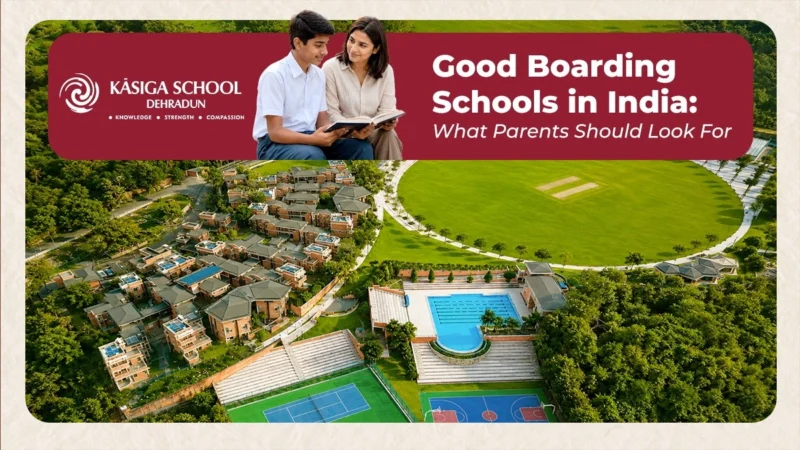
Kāsiga School lines up with a lot of what’s been covered here. It’s set on a Himalayan campus near Dehradun, away from the noise of a city and it offers both CBSE and CAIE (Cambridge) so families aren’t stuck picking one academic direction too early. With a solid sports infrastructure, a pastoral care system that’s actually staffed and present and health facilities built for boarding students specifically, the school covers most of what parents searching for good boarding schools in India are actually trying to find.
FAQs
A good boarding school balances solid academics, real safety measures, teachers who pay attention, decent hostel life and enough extracurriculars so that school doesn’t feel like just one long study session.
Curriculum fit, safety setup, hostel conditions, how pastoral care actually works day to day, the full fee breakdown and honest feedback from parents already sending their kids there. A campus visit ties all of this together.
There’s no universal right age. Some kids do fine from Class 6 or 7; others need a couple more years at home first. It depends more on the child than any general rule.
Ask about round-the-clock supervision, hostel access control, on-site medical care and what their emergency procedure actually looks like. If staff can answer these clearly and specifically, that’s usually a good sign.
Generally, yes. Living with peers day in and day out builds independence and social skills faster than most day schools can and the extracurricular time is usually more consistent too.
Generally, yes. Living with peers day in and day out builds independence and social skills faster than most day schools can and the extracurricular time is usually more consistent too.