
Class 10 results come in and suddenly a 15-year-old is expected to make one of the most consequential decisions of their life.
Science, Commerce or Arts. Each stream leads somewhere different. Each one closes certain doors and opens others. And the student making this choice (in most cases) has very little real information to base it on. They know what subjects they enjoy, maybe. They’ve heard that Science leads to engineering and medicine. They’ve been told Commerce is for business. Beyond that, it’s largely guesswork shaped by what friends are choosing, what parents expect and what seems safe.
This is where career counselling after class 10 becomes genuinely important. Not as a formality, not as a box to tick but as a real process that helps a student understand themselves – their strengths, their interests, their learning style and connect that understanding to an informed decision about what comes next.
Why This Decision Is Harder Than It Looks
Most students at the end of Class 10 are good at some subjects and less interested in others. But being good at something in school and genuinely wanting to build a career around it are two different things. A student who scores well in Mathematics might thrive in engineering or might find it deeply unsatisfying and wish they’d followed their actual passion for economics or literature.
The problem is that at 15, most students haven’t been exposed to enough of the world to know the difference. They haven’t met enough professionals, explored enough fields or had enough honest conversations about what different careers actually feel like from the inside.
Without proper career counselling after class 10, students default to the most familiar options and that’s often how capable, creative young people end up in streams that don’t suit them, carrying that mismatch all the way into higher education and early professional life.
What Good Career Counselling Actually Does
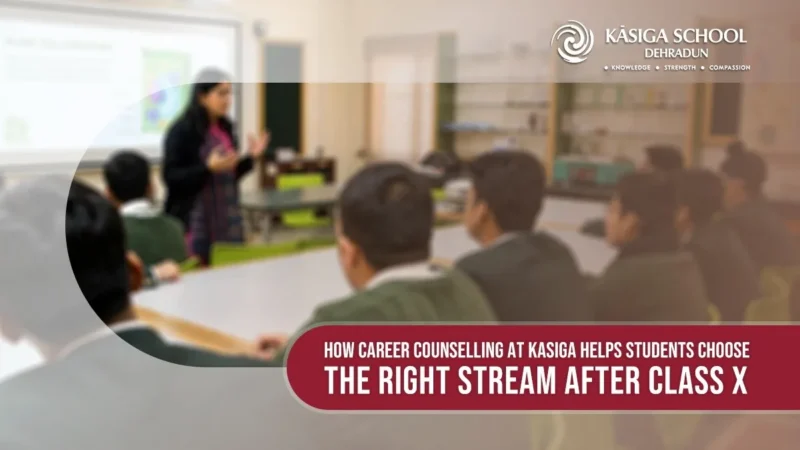
At Kasiga, career counselling is not about telling a student what to do. Our counsellors do not hand out a career prescription and send the student on their way. What they do is ask the right questions and create the right conversations.
All of it starts with understanding the student as an individual. What do they find genuinely interesting, not just what they’re good at but what holds their attention and makes them want to know more? What kind of environments do they thrive in? Are they drawn to working with people, with ideas, with systems, with creative expression? What do they find draining versus energising?
From there, the conversation moves outward to streams, to subjects, to possible career paths and to the realities of what different fields actually involve. The goal is not to narrow everything down to one answer immediately. It’s to give the student a framework for thinking about the decision clearly with enough information to make it confidently rather than anxiously.
The Role of Aptitude and Interest Assessments
One of the most useful tools in career guidance after class 10 is a properly administered aptitude and interest assessment. These are not personality quizzes. They are structured tools that measure a student’s natural strengths across different types of thinking and work such as verbal reasoning, numerical ability, spatial awareness, logical analysis, creative thinking and more.
When a student sees their aptitude results alongside their expressed interests, patterns emerge. A student who scores high on verbal reasoning and interpersonal skills but middling on quantitative analysis has useful information — information that might point toward Arts or Commerce more strongly than Science, regardless of what their peer group is choosing.
These assessments don’t make the decision. They inform it. And they give the student something concrete to discuss with their counsellor and their parents which moves the conversation away from pressure and assumptions toward something more grounded.
Involving Parents Without Letting Pressure Dominate
This is one of the more delicate parts of the stream selection process. Parents have a significant influence on what their child chooses after Class 10. When a parent’s expectations are very fixed, they can override a student’s genuine inclinations and create a decision that the student lives with reluctantly for years.
At Kasiga, good career counselling for students at this stage includes parents in the process rather than excluding them. When parents understand the basis on which a stream recommendation is being made, they are usually more open to having a real conversation rather than simply defaulting to what feels familiar or prestigious.
Our counsellor’s role is to be a neutral, informed voice in that conversation, someone who has the student’s best interests as the clear priority and who can help parents see their child’s strengths and potential in a broader context than school marks alone.
Also Read: Stream Selection After 10th: A Step-by-Step Guide for Students
Stream Selection Is the Beginning, Not the End
One more thing worth saying: choosing a stream after Class 10 is not the last important decision a student will make about their future. It’s the first of several. Students who choose Science don’t have to become engineers or doctors. Commerce students don’t have to go into finance. Arts students can build remarkable careers across law, media, design, civil services and much more.
The stream sets a direction. What matters equally is how the student develops within that direction with the subjects they choose, the skills they build, the opportunities they pursue and the ongoing guidance they receive as their understanding of themselves and the world deepens over time.
Conclusion
The choice of stream after Class 10 shapes a student’s academic identity for the next several years and the confidence or confusion with which that choice is made tends to carry forward. Students who receive proper guidance, who understand why they’re choosing what they’re choosing, move into Class 11 with a clarity that serves them throughout senior school and beyond.
Kasiga School in Dehradun understands this deeply. As a co-educational boarding school offering both CBSE and Cambridge curricula from Grade IV to XII, Kasiga has a dedicated college and career counselling program that works with students through exactly this transition. The school’s approach to stream selection is thoughtful and personalised – combining aptitude assessments, one-on-one counselling sessions and open conversations that include both students and parents.
The counselling doesn’t stop at stream selection either. Kasiga’s career guidance continues through senior school, helping students identify universities, build toward admission requirements and develop the kind of self-awareness that makes for genuinely good long-term career decisions. Students at Kasiga who have gone on to King’s College London, Ohio State University and other respected institutions didn’t land there by accident – they were guided carefully, over years, by a school that takes its responsibility to each student’s future seriously.
So if you’re looking for a school where your child will receive the academic preparation and the personal guidance they need to navigate these decisions well, Kasiga School is where that support is built into the experience from the beginning.