
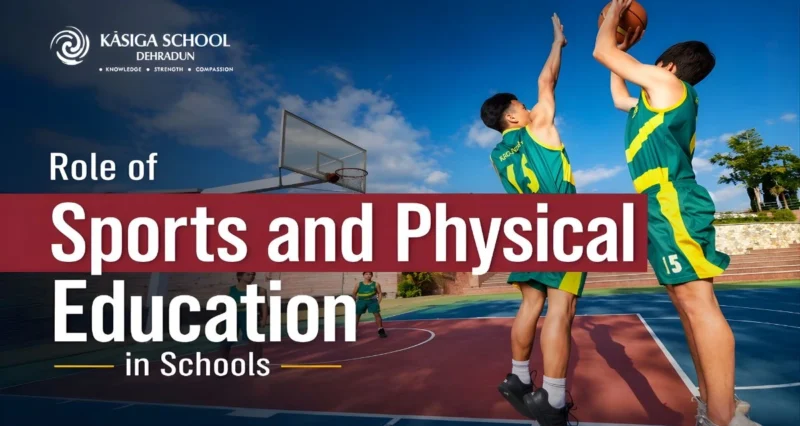
Education today is viewed as reading, learning and passing exams successfully. But education has a much deeper meaning than this. In fact, it refers to building students who are physically, mentally and emotionally strong. This is where sports and physical education make a big difference.
Understanding the importance and role of sports in schools is vital for both parents and teachers. These are not “additional” activities. Instead, they are important activities that play an important role in the development of children and their future success.
Why Physical Education Is More Than Just Playtime
Physical education is widely seen as just playing sports games or indulging in outdoor activities. Yet physical education is a systematically organised course of study which focuses on developing fitness, motor skills, personality, teamwork and mental toughness.
Studies have shown that physical education plays a very important role in the development of a child’s body and mind and helps him or her to live a more balanced life.
At the same time, schools can be regarded as one of the best places for ensuring that students participate in sports on a regular basis and thus develop their overall well-being and fitness levels.
All this further emphasises the growing importance of physical education in schools within today’s education system.
Why Sports Are Essential Alongside Education
1. Enhances Academic Performance
The foremost reason for making sports an important part of school education is the correlation it has with success in academics.
Several scientific research findings have found that physical exercise has the ability to increase focus, memory retention and mental acuity.
When students participate in sports:
• Their brains receive adequate oxygen circulation
• They gain enhanced ability to concentrate and have a good attention span
• They learn to manage their time well
In fact, several studies also suggest that there exists a very positive correlation between physical fitness and academic excellence, implying that physically active kids usually score well in their studies.
2. Promotes Physical Health and Fitness
With more screen time and a less physically active lifestyle, exercise plays an even greater role now.
Sport and physical education:
• Maintain the heart’s good condition
• Increase strength and stamina
• Contribute to maintaining an ideal weight
• Lower the likelihood of developing lifestyle disorders
Physical education also helps develop good habits that lead to an active and healthy life which further helps prevent future health issues.
3. Builds Mental Strength and Emotional Well-Being
Other than physical fitness, sports contribute immensely to the psychological and emotional growth of the students.
Active engagement in physical activities aids in:
• Maintaining low stress levels
• Improving one’s state of mind due to increased production of endorphins
• Increasing self-respect and self-confidence
Several studies also show that physical education has a positive effect on mental health as well as on the well-being of students.
Thus in a society filled with the burden of academic pressures, sports offer a perfect counterbalance.
4. Develops Teamwork and Social Skills
Classrooms teach knowledge but sports teach life.
Through team games and group activities, students learn:
• Communication and collaboration
• Respect for others
• Leadership and accountability
• Conflict resolution
Physical education provides opportunities for social interaction which enables children to make important connections and improve their social skills.
5. Instills Discipline and Time Management
Sports necessitate consistency, regular practice and dedication. Students involved in sports usually:
• Learn the value of routine
• Understand the importance of dedication
• Develop better time management skills
As a result, balancing studies and sports makes children learn how to manage priorities in life.
6. Encourages Leadership and Confidence
Whether it is taking the lead, making fast decisions on the playing field or winning and losing games, sports develop confident people.
By engaging in sports, students gain:
• Decision-making skills
• Confidence in their skills
• The courage to face challenges
Such experiences result in improved classroom participation and overall personality development.
7. Teaches Life Lessons Beyond Books
Sports are one of the few areas where children experience both success and failure in a real and immediate way.
They learn:
• How to handle failure gracefully
• The importance of perseverance
• The value of hard work
These lessons cannot be taught through textbooks but are essential for life.
8. Supports Holistic Development
Modern education is not just about academics. Educators have begun paying attention to the overall development of children by cultivating their personalities as well.
The benefits of sports in education extend across:
• Physical growth
• Emotional intelligence
• Social adaptability
• Cognitive development
Physical education serves as a bridge between all of these areas of development and ensures balanced growth.
9. Helps Discover Talent and Passion
Every child is unique and not all talents are academic.
Sports provide a platform for students to:
• Discover hidden talents
• Explore interests beyond academics
• Build a sense of identity
For many students, sports become a passion, and for many, it becomes even a career path.
10. Encourages Lifelong Healthy Habits
Children who participate in sports from an early age tend to be physically active even when they grow up.
School-based physical education programs:
• Contribute to healthy lifestyle practices
• Instil active living
• Reduce dependency on unhealthy routines
This forms the basis for a healthier community in the future.
Conclusion
The true purpose of education is not only to produce high scorers; rather, to produce capable, confident and healthy individuals. Therefore, it becomes important to understand the role of sports in schools for fulfilling this objective.
In today’s world, physical activities and sports are no less important than academics. In fact, they play an equally important role as academic education by improving the overall academic performance, improving health, building character and preparing students for real-world challenges.
For parents who wish to provide their children with the perfect environment, the choice of schools becomes very important. This is where Kasiga School stands out as the perfect option.
The reason why Kasiga proves to be a wonderful place to be admitted into is because of its academic and sport-oriented approach to education along with excellent sports facilities. Other than this, Kasiga ensures that the child is allowed to discover his/her true potential and instils a sense of toughness within him/her through teaching the life skills needed.
Because in the end, success is judged not just by marks but by one’s ability to live a healthy life, to be a good leader and to be a person with a strong personality.